Saturday, June 11, 2011

Building a New World... on Sand & Frond


How great were the summer vacations of yesteryears. All the children would retreat to their grandparents' place. Kids of the colony would get together and play the entire day regardless of the scorching heat. The children playing ‘mane aata,’ setting up homes and, in it, kitchens with miniature kitchen sets. Those games would be like dramas without scripts. The street was their stage and the story would weave itself with each passing minute. Kids would imitate their parents, uncles and aunts, grandparents and drown in their own magical world where anything was possible and they could be anybody they admire.
Now we just look back at those days and wonder where they have disappeared. With TV entering not just halls but also bedrooms and computers & video games becoming a part and parcel of daily life, children barely know of these games. Also, a variety of summer camps, coaching classes, tuitions etc., have started mushrooming to keep kids busy even during their vacations. Parents look out for those camps which will keep their wards most occupied. And the most shocking feature of the camps is that they even give children homework! Though there is nothing wrong with the camps, it is depriving the children of those innocent games which is by itself a learning process and creates a whole new world for them.
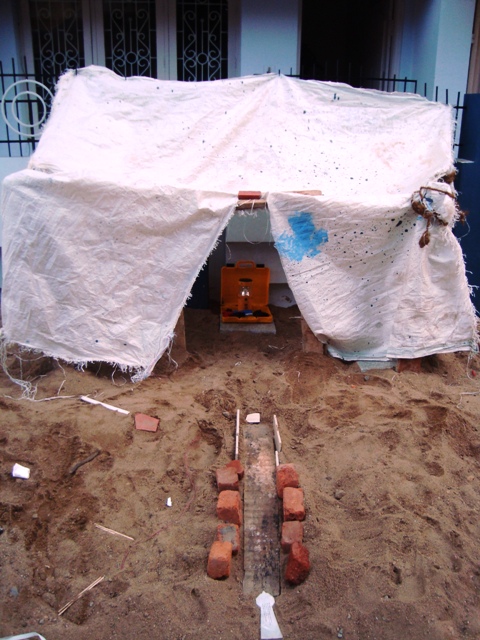
However, while walking down the streets of Saraswathipuram, we came across a bunch of kids who were spending their vacations in a different way. Cousins Dinakar Nandakishore and K.R. Madhukeshwar, 5th std. students of Amrita Vidyalayam, build a different kind of ‘house’ every day using whatever little items they may find, but with a whole lot of imagination and creativity. The foundation and flooring for these houses is the sand pit located in front of their house. If one day it looks like a tent, the other day the house goes ‘green’ with coconut fronds and the next day it looks like a temple.
The Foursome.
"During PE class in school, instead of playing football we would make teams and build houses at a sand heap located near our school. Whoever would complete before the class got over or who ever built the biggest structure would be the winner. That is when we got the idea to do the same here," say the cousins.
The duo are occasionally joined by cousins Tejas, 7th std. and Adithi, 2nd std. of Bangalore and Mumbai respectively, who have come down to their grandparents home in the same area.
Their first construction was using coconut fronds put up in the form of a tent. It started with just one frond and then they started collecting some more to make their tent better. Later on they started using wooden slabs and plastic sheets. Once the kids even went to the extent of buying chocolates from a nearby shop and started selling the same to passersby at their tent. However, on their parents advice, these little ‘entrepreneurs’ had to stop their ‘business.’
When asked if they prefer summer camps or what they were doing now, Madhu-keshwar said "In camps we have to do whatever they ask us to. But here we do what we like. That is why I did not join any camp. I don’t like restrictions. Here we can spend the entire day making different kinds of tents."
It is surprising to see that such a culture still exists among the children of this generation. At a time when parents scold kids for even playing in sand and soiling their clothes, these little 'architects-cum-builders' are attracting other children like them to join hands and just have some fun.
Children are by nature innocent. Let us not take away this innocence by introducing them to more of computer, TV, video games and other such distractions. This age once lost will never come back. So do allow kids to be kids.

(Published in Star of Mysore dated May 28, 2011)

Creating Beautiful Strokes With Knife


Artist Satyanarayan at work.
With a number of art exhibitions being organised in the recent days in city, its citizens have been introduced to almost all types of paintings, ranging from abstract to traditional, contemporary to tribal and folk, etc. Each artist brings along a fresh style, a different theme and something new to share with the people. City artist Satyanarayan is also organising an exhibition of his work consisting of a very unique style of painting involving knife work.

Knife painting by Satyanarayan.

Speaking about his style, Satyanarayan said "The purpose of an artist’s work is that his work should not be reproduced in any other medium by others. This is expected from every artist. Hence I selected knife painting as it is almost impossible to replicate the work. The patterns you get with knife painting are very different from paint brush. With brushes you get a very smooth and soft finish. It's not the same with knife. Also such strokes cannot be done using computer and software. If you observe the paintings it is not easy to copy the shades and strokes done using knife. It has various colour dimensions. My paintings consist of just 30% brush work and 70% is done using knife and takes around two days to complete one painting."

Knife painting by artist Satyanarayan.
Born on 4th Oct, 1959, Satyanarayan started working full-time at Ratnam Arts in city when he was in 5th std. While he was working there many senior artists from CAVA and other institutions would visit the place. They constantly advised him to concentrate on painting academically also. When he was 14-years-old, Satyanarayan shifted to Bangalore and joined CM Ram Arts. He would make cinema banners and cut-outs and worked as an assistant to senior artists like C.V. Ambaji, Ramchandran, Narasimhan and others. It was they who introduced him to knife work. He has also worked at Mumbai, Kerala and Chennai and returned to Mysore in 2000.

Knife painting tools.
A resident of Vidyaranyapuram in city, Satyanarayan has participated in many group shows in Bangalore and conducted classes and demos for students there. Also, in one of his exhibitions held in city in 2002, he introduced a new form called digital art.
Portraits of former Mysore Mayor Sandesh Swamy.
Speaking about his upcoming expo, Satyanarayan said "In this exhibition I am concentrating on our culture and tradition. The paintings depict temples and our everyday chores, rural life and our customs."
Presently working at Art Media in Nazarbad in city, Satyanarayan has painted two life-like portraits of former Mayor Sandesh Swamy which look no less than an actual photograph. Apart from this, he has also painted portraits of poets which now adorn the walls in Kalamandira and an 8-ft portrait of Swami Vivekananda at Sadvidya Patashala way back in 1991.
Contact Satyanarayan on Mob: 9480477044.


(Published in Star of Mysore dated June 1, 2011)

Saturday, June 4, 2011

Sir James Gordon... A Statue Sans Maintenance


Sir James Davidson Gordon
The Deputy Commissioner’s Office is one among the many heritage buildings of Mysore. The foundation stone for the building was laid on June 20, 1887 and formally opened in 1895. It was built in memory of Sir James Gordon and his statue was installed in the midst of the rose garden in front of the imposing DC office.
Son of Evelyn Meadows, Sir James Davidson Gordon was born on 1835. He joined the Civil Service in lower Bengal in 1854. He was the Private Secretary to Governor Gen. Lord Lawrence from 1866 to 73. In 1873, he became the Judicial Commissioner of Mysore, the Chief Commissioner in 1878 and Resident of Mysore from 1881 to 1882.
Also, he was the guardian to Chamaraja Wadiyar from 1871 to 1873. Sir Gordon retired in 1883 and died on June 27, 1889. He was awarded the title of CSI in 1866 and KCSI in 1881.
The DC Office
When Sir Gordon was serving as the Chief Commissioner, Chamaraja Wadiyar was the heir to the throne. Since the Wadiyar was still a minor and could not rule, Sir Gordon took care of his education and guided him with the administration. After he became the King, Gordon continued to guide him and taught him about being a leader of the masses. Sir Gordon also struggled for the welfare of the Anglo-Indian community.
The bronze statue of Sir Gordon, with a dagger in one hand and a hat in the other, though poorly maintained, stands as a testimony to time and adds beauty to this office of power.

(Published in Star of Mysore dated June 2, 2011)

Monday, May 16, 2011

The Grand Old Man Of Mysore

Thathaiah
The doyen of journalism in Mysore, thought-provoking writer, leader among freedom fighters, staunch nationalist — these are some of the words used to describe M. Venkatakrishnaiah, fondly known to all as Thathaiah.
Magge Venkatakrishnaiah (1844-1933), credited with pioneering work in the field of journalism in Mysore, wrote inspiring articles during the British reign which helped sow the seeds of nationalism. He had protested the Newspaper Regulation Act of 1908 that imposed restrictions on media. Thathaiah started newspapers like Hita Bodhini (1883), Sadhvi (1899), Vrittanta Chintamani (1885), Mysore Herald, Poura Samajika Patrike, Mysore Patriot, Mysore Review, Wealth of Mysore, Nature Cure and Sampadabhyudaya.
As a leader of the freedom fighters from city, he took lead in hosting the first session of Congress in Mysore amidst resistance. He had berated the British Raj when Bal Gangadhar Tilak was convicted of sedition in 1897. He also founded the Mysore unit of the Indian National Congress and led the Satyagraha Movement in the Princely State. Thathaiah took a lead in establishing the Mysore State Railway Labour Union to fight for the rights of the workers and supported Pinjarapole, the animal care centre. For all these and much more, Mahatma Gandhi gave him the title 'Grand Old Man of Mysore.'
Thathaiah also worked for the cause of female education and started the Maharani's School with help from Ambil Narasimha Iyengar. He took the lead to establish Anathalaya for the needy. He supported Dewan Rangacharlu to set up the representative assembly and took active interest to ensure that many social reform measures were implemented.
It is said that a few veteran freedom fighters including M. N. Jois and Agaram Rangaiah wanted to build a memorial for Thathaiah. On hearing this, Jayachamaraja Wadiyar gifted them an imported Italian marble stone which was used for the statue. Tagadur Ramachandra Rao, a veteran freedom fighter from the erstwhile Mysore State, who was popularly known as Mysore Gandhi, supervised the statue work.
The statue, in which Thathaiah is seen holding a walking stick in one hand and a book in the other along with three books placed on a stand next to him, was sculpted by S. Nagendra Sthapathi of Shilpa Kala Kendra on Ramanuja Road in city. The sculptor has shown perfection in his work right from Thathaiah’s attire, lines and wrinkles on the face to the fingers and the nerves on the hand. This life-size statue, now located in the Thathaiah Park in front of Lansdowne building, was unveiled by the then President V.V. Giri, a staunch follower of Thathaiah, on September 19, 1969. The then Chief Minister Veerendra Patil and the Acting Governor of Greater Mysore A.R. Somnath Iyer were present on the occasion.

Thathaiah Park in front of City Bus Stand
The park surrounding the statue was later developed under the aegis of Mysore City Corporation and was inaugurated by the then Education Minister H. Vishwanath on March 18, 2000.
Though daily thousands of people walk along this park in front of the Lansdowne Building and city bus stand, very few among them know the significance of the place. The statue of Thathaiah goes almost unnoticed in the hustle and bustle of city life and unfortunately, the only time it may be remembered is on the occasion of his birth anniversary.


(Published in Star of Mysore dated May 15, 2011)

Saturday, May 14, 2011

Kindari's Lilting Tunes Reverberate Thru Rangayana


Kindari Jogi at Rangayana

On the banks of Tunga River, there was once a village called Bommanahalli. The villagers were troubled not by ghosts or demons but by hundreds and thousands of vermin. The rats were everywhere — in the vessels, cheese and oil, bags of children and hats of men.
Not finding any relief, the people one day went to the Head of the village and asked him for a solution. The lazy Head, not knowing what to do, announced a huge reward to anyone who rid the village off its problem. Then came the tall and charming Kindari Jogi, who said he could take away the rats. He made a deal with the village Head and took to the streets playing his Kindari (single stringed instrument). The rats came out of their hiding and followed him to the Tunga bank where they fell into the river to meet a watery grave.
Kindari Jogi returned to ask for his money but the village Head backed from his word. Enraged by this, the Jogi warned him but the village Head refused and asked him to be gone. The Jogi played his tune again and this time the children of the village were drawn. The villagers stood watching as the Jogi led their kids away from home. He reached a mountain and the people thought it was a dead end but to their surprise the mountain split and let the Jogi and kids within; except for a lame boy who was left behind. The kid cried of disappointment as he missed the world Jogi had promised — a world where his legs would be healed and he could also dance to the Kindari's tune. But alas, he missed his friends and wept, thinking of the world they were in, taken to by Kindari Jogi, never to return again.
This is the story of Bommanahalli Kindari Jogi written by Kuvempu, which was adapted from the English version 'Pied Piper of Hamelin' by Robert Browning. This was also the first production of city’s theatre repertory Rangayana and was staged by its artistes who were then still its students. The play was staged under the direction of Rangayana’s Founder-Director B.V. Karanth. With the success of the play, Karanth wanted to make sure Kindari Jogi left his mark in the city and in the hearts of its citizens forever. Hence, he got the statue of Kindari Jogi installed in Rangayana premises which we now see.
The ever captivating Jogi
"The statue was originally designed for a tableau from Mysore for Dasara and the theme was 'Kindari Jogi' as Karanth’s drama got much acclaim then. Seeing it, Karanth decided to take it to Rangayana. But at that time it was made of iron rods and clothes. The same couldn’t be used as a permanent statue. Therefore, we re-worked it and made it out of mesh and cement. It took almost 2 months to complete the statue," says Daneshwar Muth, a native of Badami. He was a student of Chamarajendra Academy of Visual Arts (CAVA) when he made the statue of Kindari Jogi.
"The statue was not fixed inside the campus as Karanth did not want anything to be 'permanent.' However, when he was out of town, we artistes requested Daneshwar to complete the statue and install it permanently. We wanted it to be a surprise for Karanth as we wished to make this statue a symbol of the success of his play," says Dwaraknath, a Rangayana artiste.
However, over the years the statue became faded and broken. After 18 years since its installation, it finally got a facelift in 2008. Daneshwar was called back to refurbish the statue. The broken hands were replaced and it was given a fresh coat of painting. It took almost 21 days for Daneshwar to give back Kindari Jogi his original charm.
Although in the story, Jogi took the children away and never returned, he has made a place for himself in Mysore. And even to this day, we can see the 26-foot-tall Kindari Jogi welcoming one and all at the entrance of Rangayana.

(Published in Star of Mysore dated May 12, 2011)

Friday, May 6, 2011

The Wandering Monk Stands Tall


The Wandering Monk

"I consider that the great national sin is the neglect of the masses and that has been one of the causes of our downfall. No amount of politics would be of any avail until the masses in India are once more well-educated, well-fed and well-cared for."
— Swami Vivekananda

Swami Vivekananda statue at Cheluvamba Park, Mysore
This is one among the many other quotes by Swami Vivekananda, which decorates the backdrop of the majestic Vivekananda statue at Cheluvamba Park (Yadavagiri) on KRS Road in city.
In 1892, Swami Vivekananda came to Mysore for two weeks from November 9 to 24 and was the State guest of the then Maharaja Chamaraja Wadiyar. He stayed at the Niranjan Math in city prior to his visit to Chicago and the famous address at the Parliament of World Religions.
To commemorate his visit, the centenary celebrations were held for five days in 1992. A Citizen's Forum was set up to look after the programmes and from the total amount collected for the celebration, around Rs. 2 lakh was saved for installing the statue of the Swami.
This nine-and-half foot tall bronze statue was sculpted by renowned Kolkata sculptors G. Pal and Company. The location of the statue was designed for free by Mumbai's famous architect S.V. Kini and the Mysore City Corporation spent around Rs. 6 lakh on it.
The statue, unveiled by K.R. Narayanan, the then Vice-President of India, is presently being maintained by the Ramakrishna Ashram, Mysore.
One of the uniqueness of the place is that it houses not just the statue of Swami Vivekananda but also has some of his famous quotes both in Kannada and English engraved in the background. The statue, set up on an elevated platform resembling a rock, is surrounded by a pond full of lotus plants. The enclosure itself is a small park with a variety of colourful flowers enhancing the beauty of the serene place.
Other statues of Swami Vivekananda in a meditative pose are also located at the entrance of Sri Ramakrishna Vidyashala in Yadavagiri and at the entrance of the main temple at Ramakrishna Institute of Moral and Spiritual Education (RIMSE) on KRS Road.
Statue in front of prayer hall at RIMSE

Statue at Ramakrishna Vidyashala
The sculptor of the statue at the Vidyashala is Uhan Tin, a Burmese artiste. The statue has been carved from Caen Stone from England and the mantap is made of granite which has been designed by E. Ashir-vadam, an architect. The six-and-half feet statue was unveiled on Jan. 20, 1978 by L.K. Advani during the silver jubilee celebrations of the Vidyashala.
About the Swami: Swami Vivekananda was born on January 12, 1863, in Kolkata as Narendranath Dutta. He was the chief disciple of Sri Ramakrishna Paramahamsa. He is considered a key figure in the introduction of Hindu philosophies of Vedanta and Yoga in Europe and America.
After the death of his Guru, Vivekananda became a wandering monk, touring the Indian subcontinent and getting first-hand knowledge of India's condition. He later sailed to Chicago and represented India as a delegate in the 1893 Parliament of World Religions.
An eloquent speaker, Vivekananda was invited to several forums in the United States and spoke at Universities and clubs. He also established the Vedanta Societies in America and England.
Later he sailed back to India and in 1897, founded the Ramakrishna Math and Ramakrishna Mission. He died at an early age of 39 on July 4, 1902.

(Published in Star of Mysore dated May 6, 2011)

Wednesday, May 4, 2011

Serving The Society... With Love


On May 3, 1931, city resident Bhaaggeeratamma and Krishna Murthy couple had a son. Little did they know then that this boy will grow up to be an engineer, a philanthropist, an industrialist, an art patron and much more.
Krishna Murthy Venkatesha Murthy, dearly known to Mysoreans as K.V. Murthy, over the years has been constantly involved in building our society both as an engineer and as a concerned citizen. He never steps back to lend a helping hand to those in need.
In recognition of his works, he has received various awards including, 'Engineer Par Excellence' by Builders Association of India, Mysore Chapter, 'Four Avenues of Service' and 'Best Credibility President' by Rotary and 'Sangeeta Sevanidhi' by JSS Sangeetha Sabha. On the occasion of his 80th birthday, Rotary Mysore West has organised a function at Hotel Grand Maurya in city tomorrow at 6.30 pm to felicitate Murthy. In this backdrop, we spoke to the octogenarian about his 80-year-long journey. Excerpts...

K.V. Murthy
From where did your journey begin?
K.V. Murthy (KVM): I was born and brought up in Mysore. My schooling was at Vontikoppal Govt. School, which was the best school in those days. The present External Affairs Minister S. M. Krishna was my classmate in middle school. At that time we had only four students who had passed in first class and Krishna and I were among that four! After finishing school, I joined Maharaja College, later did B.Sc, BE in Civil Engineering from NIE and Masters in Geo-technology.

Did you choose civil engineering out of interest?
KVM: From my younger days I wanted to have two degrees and hence B.Sc and BE. At that time, there was no Information Technology or Computer Science. We had only four options — Civil, Mechanical, Chemical and Electrical. And I loved civil. When India won independence, there was a lot of growth in infrastructure. Our country was in the development stage and many dams, bridges, buildings, docks etc. were being constructed. For all this, civil engineering is the basic. Even today the course has a lot of demand.

How were your days as a civil engineer?
KVM: Immediately after studies I left Mysore and went to Baroda to join Bombay PWD. But I didn’t want to continue in government sector. In 1958, I came to Bombay and joined a private construction company. My first assignment was in Indian Institute of Technology (IIT), Powai. On Mar.10, 1959 Jawaharlal Nehru laid the foundation for its Administrative Block. When that project was underway, another company, which was observing my work, asked me to work for them on a project in Sharavati. The lure of coming back to my native made me pack my bags. I was involved in the construction of Linganamakki Dam. After that, from 1959-1987, I worked with Hazarath Construction Company. After the workers took over the company, we had our own technology and were undertaking marine and harbour works, construction of bridges, dams etc. I was also involved in the setting up of the first full-fledged container terminal in Chennai in 1983 which was completed in just 18 months time. The then Prime Minister Indira Gandhi had inaugurated it. I have worked at almost all the ports in India and have travelled across the country as an engineer.

With such a busy career, when did you get involved in social service and how was your experience as a Rotarian?
KVM: Why has God given money? You obviously won’t take it while leaving. So I started to serve the society. My wife Lalitha and I have three daughters. One is a doctor at Manipal Hospital and other two are engineers. Once they were married, we were left alone and then I shifted to social service. Few friends and I took up some voluntary work and the result of it is the present facilities at Chirashanthi Dhama Crematorium in Goku-lam, Nadabrahma Sangeetha Sabha and a few others. We have established a Sangeetha Sabha called Raaga Vaibhava. I helped in certain reconstruction work at the Kanteerava Narasim-haraja Sports Club and saved more than Rs.10 lakh for the Club. Also, when I was the President of Rotary Mysore West, we provided many facilities at the Rotary West Institute for Mother and Deaf Child, including the construction of residential quarters for the mothers.

When was the seed of music planted in you?
KVM: I was exposed to music from my childhood days. My parents used to sing very well. Later on I got busy with my job. In Mumbai, we didn’t have Karnatak music, but my wife and I would attend concerts of stalwarts like Mukesh, Rafi, Lata Mangeshkar, Asha Bhonsle, Hemanth Kumar etc. I got back in touch with classical music after returning to Mangalore. But Chennai quen-ched my thirst for music when I got to know great musicians like Ramani, Lalgudi Jayaraman, Maharajapuram Santanam and M.S. Subbulakshmi. I would arrange for their concerts in front of a few invited audience at my residence there. Because of this, I came to be known as Madras Murthy among my friends! Also, during my second dau-ghter’s marriage Lalgudi Jayaraman gave a concert for free just out of friendship.

You have been an engineer, an art patron, philanthropist and now also an industrialist. Tell us a little about your industry.
KVM: I am currently the Chairman of Pragati Group at Belagola Industrial Area in city. We are involved in the production of plant growth regulators, micronutrients and pesticides. We are also into producing instant food and have made instant coffee decoction.

What has been the driving force behind you?
KVM: I have come up the hard way. But my parents brought me up with good character. They would always ask me to study, share and serve the society. In my 35 years of service, all you can find is dedication and hard work. I have immense belief in God. And all my work is dedicated to God and my parents who gave me character and taught me how to behave. I am from a very poor family and whatever I have today is hard earned. But I have inherited the good character and guidance given by my parents. Also my wife has been a great support as she took good care of our children when I was busy with my career.

Seeing your journey, many youngsters will consider you as their role model. What is your message to them?
KVM: My only message is 'work'; working not out of fear or favour but with love. You should not expect anything in return. If you want to do something, then do it out of love. Else you'll be left disappointed and sad. Work is worship and working is in my blood. This has been my motto throughout my life and I advice the same to others also.
D.V. Gundappa, in one of his Mankuthimmana Kagga, says work not for the sake of it, your work is your dharma, do your work happily and work without expectation. This is my message for youngsters.

(Published in Star Of Mysore dated May 2, 2011)